
Russian Rule 1815 - 1915
A general overview

Following the defeat of the French army in Russia, the retreat was devastating. Many soldiers perished from the cold or drowned in the lakes surrounding Vilkovishk; ultimately, 80 French soldiers and three generals were buried in the vicinity of the town. In 1815, following Napoleon's final downfall, the region was annexed to Russia. Vilkovishk was initially included in the Augustowa Gubernia, later becoming a district center within the Suwałki Gubernia in 1866.
Industry & Infrastructure
Under Russian rule, Vilkovishk transformed into a vital commercial hub:
-
Military & Manufacturing: The Russians constructed large barracks and established several factories, including facilities for producing spirits and extracting oil.
-
Trade Hub: Massive storehouses were built to house locally produced and imported goods, which were then distributed to neighboring towns.
-
The Bristle Industry: By the late 19th century, the town became a major center for processing pig bristles. By 1900, this industry alone employed approximately 1,000 workers.
Gateway to the West: The Great Migration
In the 1880s and 1890s, Vilkovishk became a critical transit point for Jews fleeing Russia for America. Because the town was so close to the border, many arrived here hoping to cross into Germany without passports.
-
The Smugglers: For financial or political reasons, many took the risk, but often were caught by the Russian Border Guard. The Vilkovishk community took it upon themselves to intervene and free these detainees from jail.
-
A Solemn Warning: In 1898, the community leaders published a formal warning in the Warsaw-based Hebrew newspaper Hatsefira, advising against illegal crossings.
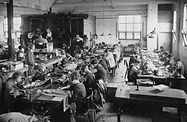


Processing pig bristles; a major local industry by 1900
Russian military barracks and warehouses, circa 19th century
Commerce, Land, and Resilience
-
The Jewish community was the backbone of the economy, trading in grain, timber, and agricultural products. Uniquely, under the Napoleonic Code, Jews here could own land and cultivate large fields. Despite devastating fires in 1882, 1886, and 1905, the community persevered with aid from international benefactors like the Barons Rothschild and Hirsch.
The Birth of Labor Rights
-
Vilkaviškis was a pioneer for workers' rights in Lithuania. In 1911, 1,000 bristle workers struck to achieve an eight-hour day—the first in the country to do so. The "Bund" party played a key role here, fostering both political activism and Yiddish culture among the working class.
-
Spiritual Life & Sacred Records
The town's spiritual landscape was rich, featuring the Old Synagogue, the "Beth Midrash," and several specialized "Klois’es." The brush workers even maintained their own house of prayer, "Chevrath Sh’Ch," established in 1875. The community's deep roots are evidenced by the Chevrath Mishnah ledger, which dates back to 1761.

Families preparing for the journey to America via Germany

Pioneers of workers rights

Remnants of Vilkovishk following the devastating fire of 1905

The Old Synagogue, a center of communal life and record-keeping.
Below you will see the aspects of Jewish life in Vilkaviskis during the Russian period