

The Duchy of Warsaw 1806 - 1815
After Napoleon defeated Prussia and according to the Tilzit agreement of July 1807, Polish territories occupied by Prussia were transferred to what became known as the "The Great Dukedom of Warsaw", which was established at that time. The king of Sachsonia, Friedrich-August, was appointed duke, and the Napoleonic code now became the constitution of the dukedom, according to which everybody was equal before the law, except for the Jews who were not granted any civil rights.
During the years 1807-1813, Vilkovishk belonged to the "Great Dukedom of Warsaw" and was part of the Bialystok district. The Napoleonic Codex was then introduced in this region, remaining in effect even during the Lithuanian period.
1808 Census: Under the Duchy of Warsaw, the first systematic records showed that the Jewish community made up over 80% of the town's population, establishing Vilkaviškis as one of the most significant Jewish centers in the Suwałki region.


In the summer of 1812, Napoleon, with a huge army of about 250,000 soldiers, stayed there for 4 days, causing great damage to the residents of the town and its surroundings. Napoleon told a delegation of Vilkaviskis Jews, who had approached him requesting that the army stationed there remove their horses from the synagogues - it being before "Tisha beAv" (ninth of Av) and the Jews wanted to mourn the destruction of the Temple in Jerusalen, - that he had been in Palestine with his army in 1798-99, and that if he managed to conquer that land he would re-establish the Jewish Kingdom.
What happened in Vilkaviškis
Direct local effects
-
Requisitioning and damage: Feeding, housing, moving, and supplying so many troops and horses placed exceptional pressure on the town and its surrounding farms. A Vilkaviškis Jewish historical account specifically says the army’s four-day stay caused great damage to local residents and the surrounding area.
-
-
Synagogues used for horses: According to that same community account, a Jewish delegation appealed to Napoleon because soldiers had placed horses in the synagogues shortly before Tisha b’Av. This illustrates the immediate intrusion of the army into religious and daily life.
-
-
Death and aftermath: After the catastrophic campaign in Russia, retreating French soldiers passed back through the region in severe winter conditions. The local account says soldiers froze or drowned in lakes around Vilkaviškis, and records burials of 80 French soldiers and three generals
-
-
A disrupted community: Residents faced fear, forced provisioning, loss or damage to property, interruption to trade and worship, and uncertainty about which army or authority would control the area next. Evidence for those last effects is contextual rather than a complete local tally, so they should be presented as likely consequences, not a measured record for every household.


Reinactment of the French invasion of Russia that took place in Vilkaviskis

Prof. Dr. Ruth Leiserowitzs
Is a distinguished German historian, she researches 19th–20th century Eastern European history as well as Jewish history in the Baltic-Polish region and former East Prussia. From 2009 to 2024 she served as Deputy Director of the German Historical Institute in Warsaw. Since April 2025, she has been a senior researcher at the Institute of Baltic Region History and Archaeology, Klaipėda University.
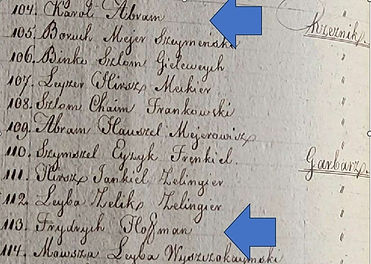
Dr. Leiserowitz has written a fascinating article "Tax lists from the first half of the 19th century as sources for family and community research " Click on the PDF logo to read this fascinating and important article